ABC Radio Nightlife Interview

Media

Screen Shot 2019-10-25 at 9.16.40 am.png

Last night Jesse Adams Stein joined Associate Professor Leanne Wiseman and Guido Verbist (The Bower), on ABC Radio’s Nightlife program, hosted by Suzanne Hill. (Listen to the full program here – fortunately our bit is in the first hour.) The type of interview is a nice format – a whole hour to discuss repair, the right to repair, and how design and law intersects with these issues. Callers rang in to discuss their frustrations with corporate monopolised control over repair industries and the problem of proprietary software. Automotive repair featured dominantly in this discussion which was interesting, as it’s often other kinds of objects that are highlighted (sometimes it’s kitchen appliances that take the focus). As always, iPhones were also the centre of some people’s outrage, no surprises there! Everyone has a story about broken things they tried to fix and couldn’t. These personal stories will be central to mobilising public engagement with repair and design issues.

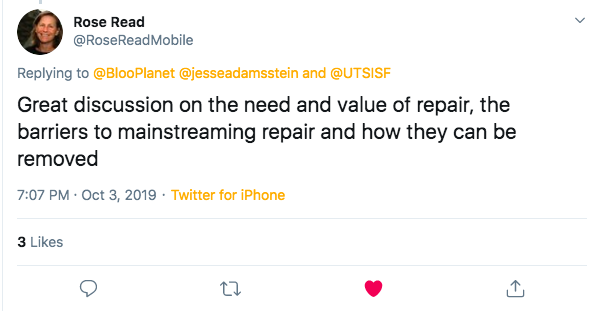
It was also great to see our program was listened to by Nathan Proctor, Head of the Right to Repair Campaign (US) with the United States Public Interest Research Group (USPIRG).

Screen Shot 2019-10-25 at 9.21.24 am.png

While Australian discourse on repair may be well behind the US – in terms of political advocacy and general public awareness of the legal possibilities for reform – there are also important differences jurisdictionally and culturally which will mean that any kind of ‘right to repair’ movement will play out differently in Australia compared to the US or the EU. As Guido said when leaving the ABC Studios after the interview – just wait, in a year’s time the political discourse about repair in Australia will be completely different.
The Maintainers, Washington DC, Oct 6-9

field trips, research in process

By Ali Crosby

The Maintainers is a global research network interested in the concepts of maintenance, infrastructure, repair, and the myriad forms of labor and expertise that sustain our human-built world. This October I attended the third of their series of conferences. I gave a paper about Frontyard as a collective maintenance project in a city with smart city agendas on the horizon. On the panel was Pamela Robinson, Kevin Rogan, and Carole Voulgaris.

First a few notes on the event itself, which was structured around four tracks (information, transport, software and a general track), and also included an unconference track and workshops such as the mending as protest. While there were lots of scholars there (from STS, history, engineering, information and computer sciences) it was not only an academic conference. Rather, people were talking through practice, about projects they maintain in government institutions, not-for-profits, companies and universities. The goals to bring practitioners, policy-makers, researchers, and activists together was clear.


Collaborative notes were set up on day 1 for each track. These are available here: General Track: http://bit.ly/miii-notes-general… Information Track: http://bit.ly/miii-notes-info Software Track: http://bit.ly/miii-notes-software… Transportation Track: http://bit.ly/miii-notes-transportation2

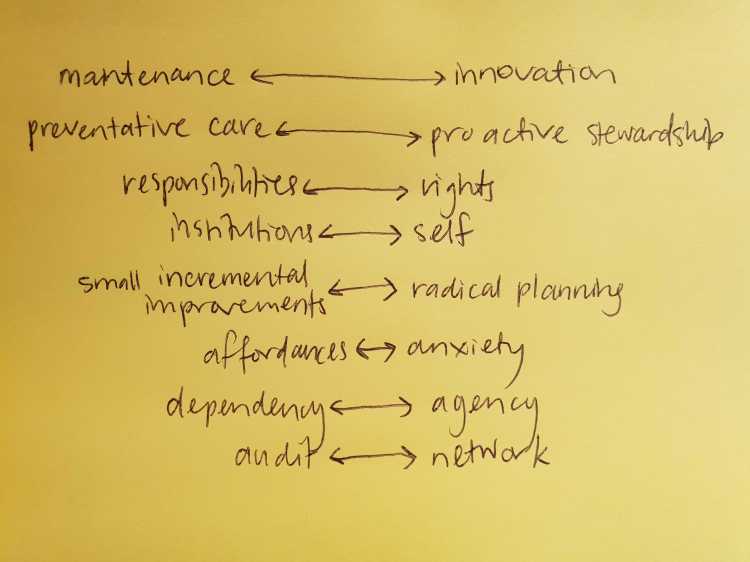
In terms of highlights relevant to our work on repair in Australia, the concept of stewardship and care was strong throughout the conference. This included recurring questions about responsibility and exploitation as well as an acknowledgement that maintenance covers a diverse range of practices , both preventative and reactive, which often are driven by a moral imperative. In a neoliberal context, volunteering to look after infrastructure, for example, lets corporations and governments off the hook.

The perceived tension between innovation and maintenance came up often, as participants were there to improve things, and also to look after what we’ve got. This is relevant to software (do you work on an imperfect open source project or start something different?), transport (are current public transport networks the best way to ensure mobility for all sectors of societies? I think of the variety of systems in Jakarta and the lack of real commitment to any of them), and information (archiving protocols need to be decolonised, and records need to be tended, which the work of Kirsten Thorpe has helped me understand).

And the other ‘take-away’ (that’s what they say here) is that maintenance and repair may be a global movement, we may share tools and approaches, but local applications vary. Global systems are the most difficult to maintain, so why would we do that to ourselves? The Maintainers, like no other collective project I have come across, is committed to the myriad forms of labor and expertise that sustain our human-built world. But this world is from a US perspective, which has its limitations, most noticeable as an outsider (e.g. Mel Gregg gave a great keynote, referring several times to the ‘strange’ sales culture that drives social relations and therefore work practices in California) . In the UK, activists (such as the wonderful Laura James) have worked on their own version of The Maintainers to create The Festival of Maintenance. I wrap up by asking, what are we going to do in Australia?